

What the science says about where your relationship with food actually began…and why that matters now
Having a complicated relationship with food isn’t something that people voluntarily opt into.
It just develops. Much like other complex relationships, it’s shaped from a young age by things that you’re not even aware of…slowly, steadily and often, under the radar…and by the time you start to notice and question, it’s already there to stay.
Does this mean something is wrong with you? Absolutely not. But it may be helpful to know how these relationships tend to develop. Some things may resonate while others don’t.
Before You Knew What Hunger Was
Did you know our relationship with food starts even before our memory does!
Pretty much from the very beginning, food is not only nutrition but something that brings us comfort, a sense of security and most importantly, connection. And our brains register all of this information and start building associations. From the start, food and emotional regulation are learned alongside each other (Birch, 1999). That association is not only natural, it’s one of the earliest patterns that our brains remember.
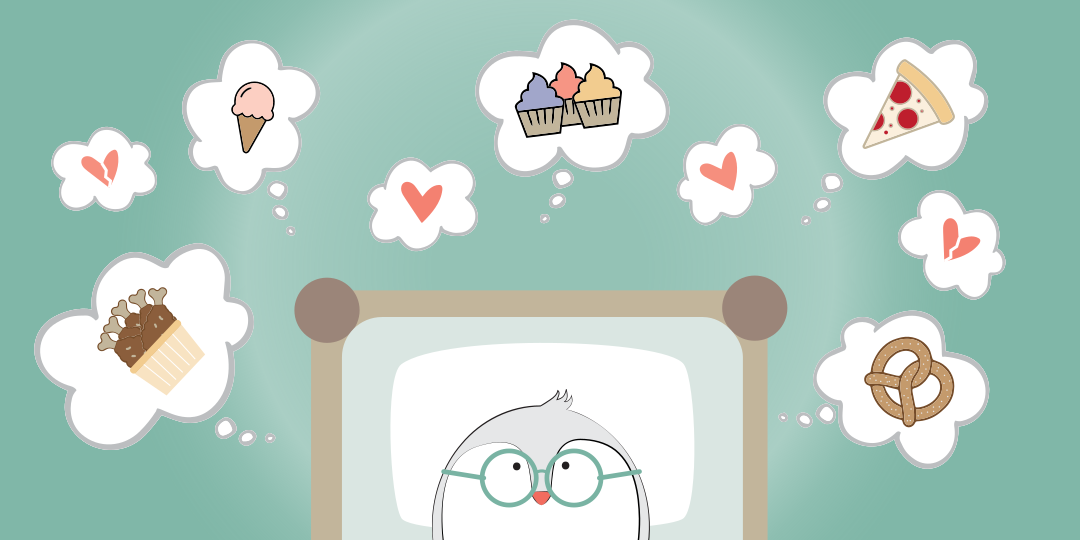
As we enter childhood and beyond, food continues to take on deeper meaning. Food marks celebrations and comforts losses. It often serves as a reward and can be attached to the feeling of safety. And, quietly, the brain takes it all in - without any instruction or permission.
And when a child is comforted and soothed with a treat, something sweet to lift their spirits, this isn’t retained as a “bad habit”. Rather, the brain registers this as a solution.
What Food Learned to Do
Notice what’s happened here? Food is no longer just food.
It’s a celebration for some. It’s a reward for others. It’s a refuge or maybe a memory. A companion in loneliness. A faithful friend who never betrays…or leaves. A rock when everything else seems to be spinning out of control.
And the thing is, the brain sees every single one of these as a solution to something, because somewhere in your history, food was exactly these things. So your brain filed it away as something tried, tested and approved, but without context and without filter.
Research on how emotions influence eating has identified multiple pathways through which emotional state shapes food behavior (Macht, 2008). The pattern is different for everyone, shaped by the specific food history in a particular nervous system over the course of a life. The brain learned that food changes how you feel. And because brains are good at recalling solutions that work, it will continue feeding this information to you without considering the long-term impact. So, it’s not a you problem. It’s a faulty learning system that just keeps doing what it thinks is helpful.
The Body’s Logic
But wait. There’s more. Did you know that your body will literally release a hormone called cortisol when it starts to feel stress?
What does cortisol do? It directly affects food preference. Elevated cortisol increases the brain’s drive toward foods high in fat and sugar, not because of a lack of discipline, but because the stress response is doing exactly what it evolved to do: seek fast, dense energy in response to perceived threat (Dallman et al., 2003). And when those foods are consumed, insulin spikes to manage the surge. Stress. Sugar. Insulin. Over time, it becomes a cycle the body knows by heart.
When the brain is stressed out, it looks for relief. And it already knows that it’s not going to find it in a balanced meal.
What a GLP-1 Changes - and What It Does Not
That brings us to GLP-1 receptor agonists. Finally, right? You might be muttering to yourself, “it’s about time.” And you know what? It’s okay to say it out loud.
Because GLP-1 medications don’t perform magic. They change biology. For real. They mimic a natural hormone your body already makes, one that helps regulate hunger, fullness and how strongly your brain responds to food. The hormone that sometimes just doesn’t work like it’s supposed to for some. So the GLP-1 receptor agonists step in to restore the function - to help quiet the food noise, to recalibrate the hunger signals. With GLP-1 medications, many people experience changes in their eating patterns that were impossible to control, making them…well, controllable.
This doesn’t mean GLP-1 medications wipe out your history with food. Your brain still retains the food associations and your learned patterns don’t magically disappear. But the “noise” from your brain dims. And for some people, this helps to reveal a relationship with food that was there all along - driving certain behaviors - but buried underneath all the noise. It can be a huge relief. But it can also feel uncomfortable and overwhelming.
Research on long-term outcomes after weight loss consistently suggests that people who engage with the behavioral and emotional dimensions of their relationship with food tend to sustain results more durably than those who address only the physiological piece (Wadden, Tronieri & Butryn, 2020). Simply put: it’s not just about the medication, it’s also about working on the relationship itself.
The Space That Opens
When the noise settles down, space appears. Space that was previously occupied by the constant pull from a demanding relationship.
What you do in that space differs for everyone. But it’s important to know that that space is there. Because that space opens you up for more visibility.
Research on interoceptive awareness - the ability to read the body’s internal signals, including genuine hunger and fullness - suggests that developing this attunement is associated with meaningful changes in how people relate to food over time (Herbert & Pollatos, 2012). The medication doesn't create the change. It creates the conditions where change becomes more possible.
Your relationship with food is a part of who you are. The goal isn’t to try to remove it. It’s to see it for what it is, and to work on developing a healthier one. As with any important relationship, this one also takes work.